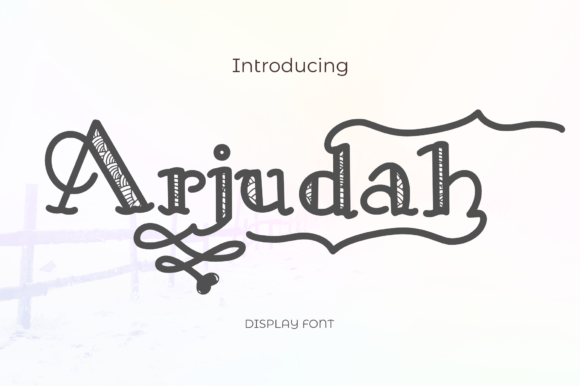
Arjudah: A Display Font That Adds Warmth and Polish to Your Brand
Last Tuesday, I was helping a local candle maker update her jar labels—simple kraft paper tags with hand-stamped scents like “Sage & Sea Salt” and “Vanilla Amber.” She’d been using a free handwritten font for months, but something felt off: the letters looked stiff, disconnected, and oddly generic. When she switched to Arjudah, the change wasn’t dramatic at first glance—but customers started commenting. “Your labels look *so much more intentional*,” one said. Another asked, “Did you hire a designer?” She hadn’t. She’d just chosen a better display font.
What Makes Arjudah Feel Like a Real Brand Asset?
Arjudah is a modern handwriting display font—not a rushed sketch or an overly ornate script, but something that breathes. It’s casual without being sloppy, elegant without feeling distant. The subtle swashes (those graceful, extended strokes on letters like y, g, and f) add movement and personality, while the consistent letter spacing and balanced weight keep it legible and grounded. Think of it as the kind of handwriting you’d use when signing a thank-you note to someone you genuinely admire: warm, confident, and quietly thoughtful.
As a display font, Arjudah isn’t meant for paragraphs or fine print—it shines where attention matters most: logos, product names, packaging headers, social media banners, and short brand phrases. It’s not trying to be everything; it’s designed to elevate the moments your customer first connects with your brand.
Where It Works Best—And Where to Use It Thoughtfully
We tested Arjudah across real small business touchpoints:
- Product packaging: On a lavender-scented candle label, “Lavender Fields” in Arjudah stood out cleanly against muted linen paper—no extra design flourishes needed. The swashes added charm without competing with the minimalist aesthetic.
- Café menus: Used for section headers (“Pastries,” “Specialty Drinks”), it softened the visual tone of a clean sans serif body font—making the space feel inviting, not clinical.
- Thank-you cards & stickers: Printed on recycled cardstock, Arjudah held up beautifully at 14–16pt sizes. No blurring, no thin-line breakage—even on lower-DPI home printers.
- Instagram story templates: Paired with a crisp sans serif for captions, Arjudah gave promotional graphics instant warmth and distinction in crowded feeds.
- Online shop banners: As a hero headline over lifestyle photography, it created hierarchy and emotional resonance—customers paused longer, scrolled less.
That said, readability still matters. On tiny jar labels under 10pt, we recommend using Arjudah only for the scent name (e.g., “Honey Myrrh”)—not full descriptions. For mobile thumbnails or small digital ads, stick to 3–5 words max, and always test on actual devices before finalizing.
How It Builds Trust—and Why That Matters
Typography shapes perception faster than most of us realize. A poorly matched or low-quality font can unintentionally signal “this isn’t quite finished yet.” Arjudah, by contrast, feels considered and cohesive—like the brand has taken time to get the details right. That impression translates directly into perceived trustworthiness, especially for handmade, wellness, or lifestyle businesses where authenticity and care are part of the value proposition.
It also supports consistency. When you use Arjudah for your logo, then again for your packaging header and Instagram highlights, customers begin to recognize that rhythm—the gentle curve of the a, the confident tilt of the r. That’s how visual memory forms. Not through repetition alone, but through repetition with character.
Smart Pairings and Practical Tips Before You Download
Arjudah pairs effortlessly with clean, neutral fonts—especially geometric or humanist sans serifs like Montserrat, Inter, or Poppins. These combinations let Arjudah lead with personality while keeping supporting text clear and functional. Avoid pairing it with other decorative scripts or overly condensed typefaces—they’ll compete rather than complement.
Before licensing Arjudah for commercial use, double-check what’s included: most versions offer OpenType features like alternate characters and ligatures (great for avoiding awkward letter collisions), multiple weights (though Arjudah is typically a single-weight display font), and standard file formats (OTF, TTF, WOFF). Confirm multilingual support if you serve diverse communities—and always verify the license covers physical products (like candle labels or bakery boxes) and digital templates (like Canva kits or Shopify banners).
One last note: Arjudah isn’t about looking “fancy.” It’s about looking like *you*, just more fully realized—thoughtful, grounded, and ready to connect. Whether you’re printing 20 tags for a farmers’ market stall or designing your first Etsy banner, it’s the kind of display font that makes your work feel seen, not just seen-through.